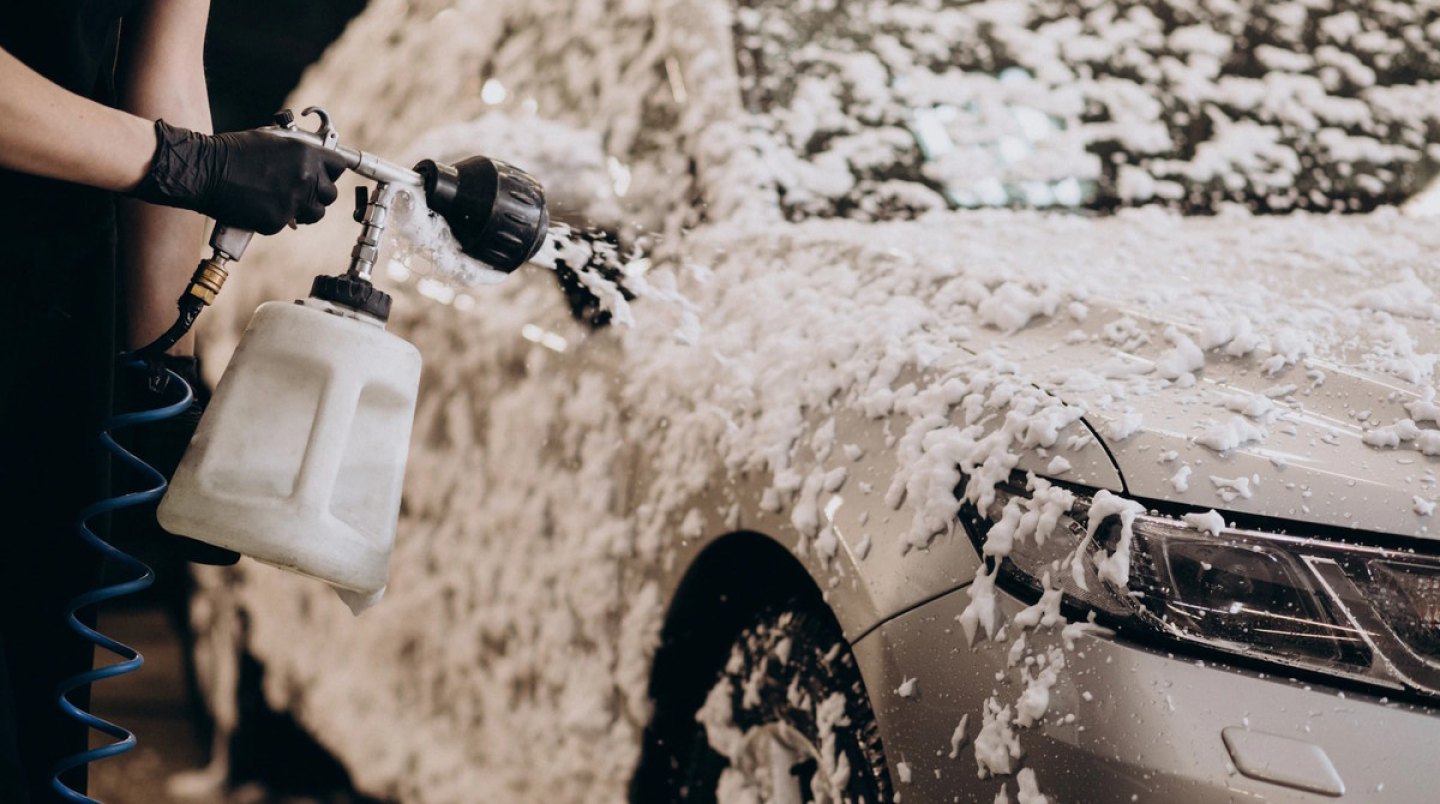
A good ceramic coating protects your paintwork for years, not weeks. That's the real difference between a coating and a traditional wax — wax gives you a few months at best, while a professionally applied coating is measured in years. This guide covers what ceramic coating genuinely does, how the different grades compare, what it costs, and what to watch out for. We apply it as a mobile service across West London, so we've included what that looks like in practice.
Key takeaways
| Point | Details |
|---|---|
| What it is | A liquid polymer that chemically bonds to your car's factory paint, forming a hard protective layer over the clearcoat. |
| Types | Professional-grade (2–5 years), consumer-grade DIY (up to 2 years), and hybrid coatings (1–2 years). |
| Benefits | Repels water and dirt, blocks UV damage, resists chemical staining, and makes washing far quicker. |
| The catch | The preparation matters more than the product. A coating locks in whatever is underneath it, swirl marks included. |
| Ecoverde | Paint protection starts from £480, applied at your home or workplace anywhere in West London. |
Table of contents
- What ceramic coating actually is
- The three grades explained
- What it protects against
- Ceramic coating in West London
- Application and aftercare
- Ceramic vs wax vs PPF
- Costs and common mistakes
- FAQs
What ceramic coating actually is
Ceramic coating is a liquid polymer that bonds chemically with your car's factory paint rather than sitting on top of it like wax. Built around nano-ceramic particles — usually silicon dioxide (SiO₂) or titanium dioxide (TiO₂) — it cures into a thin, hard, water-repellent layer over the clearcoat.
In practice that gives you:
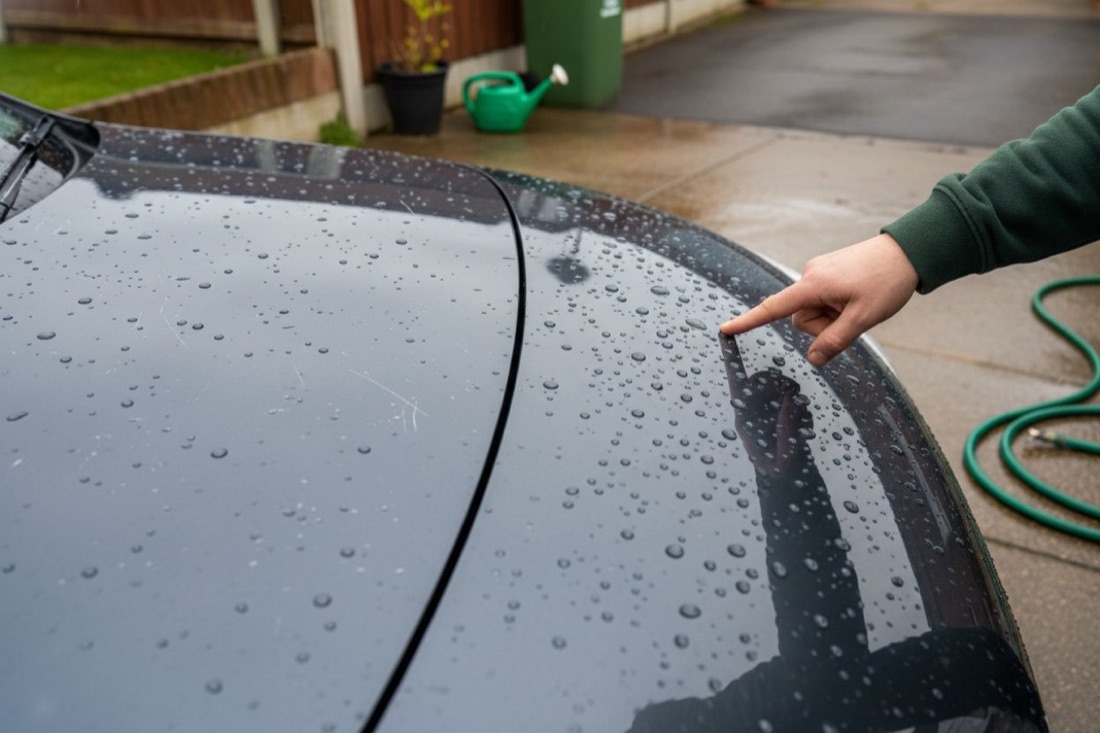
- Water and dirt that bead and slide off rather than clinging
- A barrier against UV fade and oxidation
- Real resistance to acidic contaminants — bird lime, tree sap, road salt
- Noticeably deeper gloss, particularly on dark paint
- Much faster washing, because less grime grips the surface
The durability is the headline difference. A carnauba wax gives you roughly four to eight weeks in UK conditions. A properly applied professional coating is measured in years — typically two to five, depending on the product and how the car is looked after.
See what's involved in our ceramic coating and paint protection service.
The three grades explained
Ceramic coatings aren't one product. There are three broad grades, and the right one depends on how long you're keeping the car and how much preparation the paint needs.
| Type | Durability | Application | Best for |
|---|---|---|---|
| Professional-grade | 2–5 years | Expert only | Cars you're keeping; dark or new paintwork |
| Consumer-grade (DIY) | Up to 2 years | Moderate | Enthusiasts happy to do the prep themselves |
| Hybrid | 1–2 years | Straightforward | A step up from wax without coating money |
Professional-grade
Higher concentrations of SiO₂ or TiO₂, and the most demanding to apply — they need controlled conditions, thorough decontamination and usually machine polishing first. In return they last longest and give the strongest gloss.
Consumer-grade
Sold for DIY use and more forgiving to apply, typically lasting up to two years. The products are genuinely decent now; the limiting factor is almost always preparation rather than the bottle.
Hybrid
A middle ground blending ceramic chemistry with easier, sealant-like application. Expect one to two years, balanced water repellency, and far less fuss — a sensible option if a full coating is more than the car needs.
What it protects against
Coatings are often sold on gloss, but the protection is the substantive part. A coated panel defends against:
- UV damage and oxidation — the slow fade that ages red and dark paint first
- Bird droppings and tree sap — acidic enough to etch clearcoat within hours in warm weather, and a genuine problem on West London's leafy residential streets
- Winter road salt — corrosive, and unavoidable from December onwards
- Traffic film and brake dust — the grey haze that dulls a finish over months
An important caveat: a coating is not armour. It won't stop stone chips or resist a careless brush at an automatic car wash. What it buys you is time — a bird dropping on a coated panel can usually be lifted off cleanly the next morning, where on bare clearcoat it may already have etched a mark that needs machine polishing to remove.
Ceramic coating in West London — how mobile application works
We apply ceramic coating as a fully mobile service across West London, including Chiswick, Ealing, Kew, Brentford (TW8), Ladbroke Grove (W10), Richmond and Twickenham. The van carries its own water and power, so nothing is needed from you beyond somewhere to park.
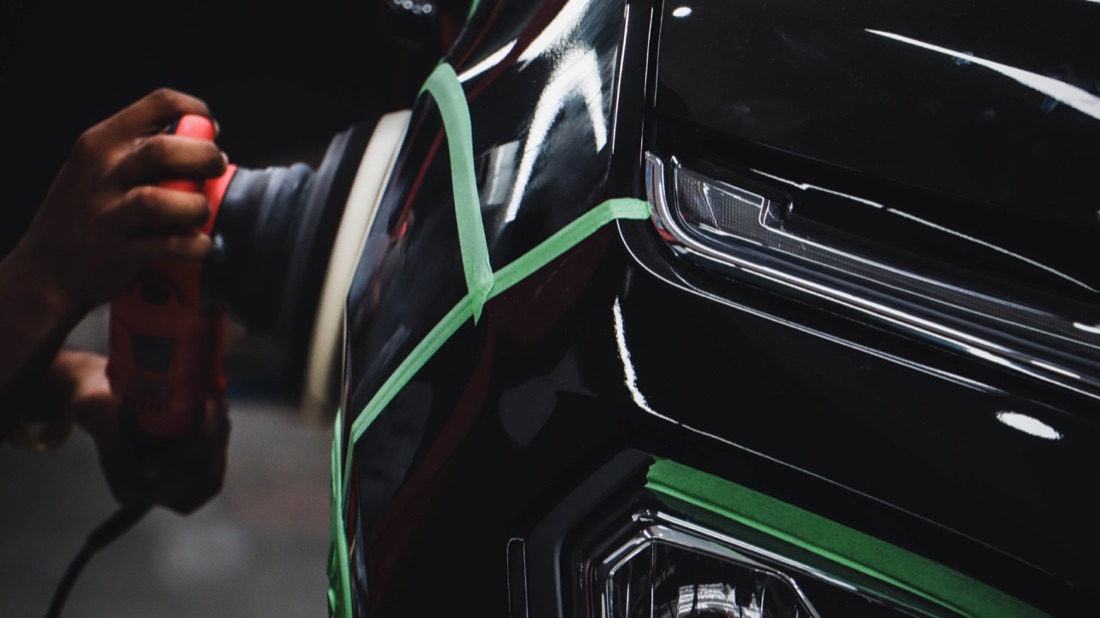
Every application starts with a full decontamination wash and, where the paint needs it, machine polishing to remove swirl marks before any coating goes on. That order matters: a coating seals in whatever is underneath, so correcting the paint first is what makes the difference between "shiny" and genuinely transformed.
Two practical points specific to mobile work:
- It's a dry-day job. Coatings need a dry, stable surface to bond properly, so we book around the forecast and reschedule rather than rush it in drizzle.
- Shelter helps. A garage or sheltered driveway is ideal, since anything landing on wet coating causes high spots. If you have a garage, say so when you book.
Paint protection with us starts from £480, with the final price depending on vehicle size and the condition of the paint. Send a few photos with your enquiry and you'll get a firm figure rather than a guess.
Application and aftercare
How it's applied
- Decontamination wash to remove surface grime
- Chemical decontamination and clay treatment for bonded iron and tar
- Machine polishing where the paint needs correcting
- Panel wipe to strip every trace of polishing oil
- Coating applied panel by panel and levelled at the right moment
- Initial cure — the car must stay dry for the first 12–24 hours
Steps one to four are most of the labour and most of the cost. A quote that's dramatically cheaper than everyone else's has almost certainly skipped them.
Looking after it
- Wash with a pH-neutral shampoo — harsh detergents shorten a coating's life
- Use the two-bucket method with a clean mitt, never a brush
- Avoid automatic car washes entirely; spinning brushes undo the work
- Dry with a soft towel or blown air to prevent water spotting
- Remove bird droppings and sap promptly, even on a coated car
- No washing at all for the first seven days after application
A ceramic maintenance spray every few months refreshes the water-repellency and extends the coating's useful life.
Ceramic vs wax vs paint protection film
| Lasts | Strengths | Limitations | |
|---|---|---|---|
| Carnauba wax | 4–8 weeks | Warm, deep gloss; inexpensive | Breaks down quickly, especially over winter |
| Synthetic sealant | 4–6 months | Good value, sharp gloss | Less durable than a coating |
| Ceramic coating | 2–5 years | Chemical resistance, easy washing, gloss | Won't stop stone chips; needs proper prep |
| Paint protection film | 5–10 years | Physical impact and chip protection; self-healing | Considerably more expensive |
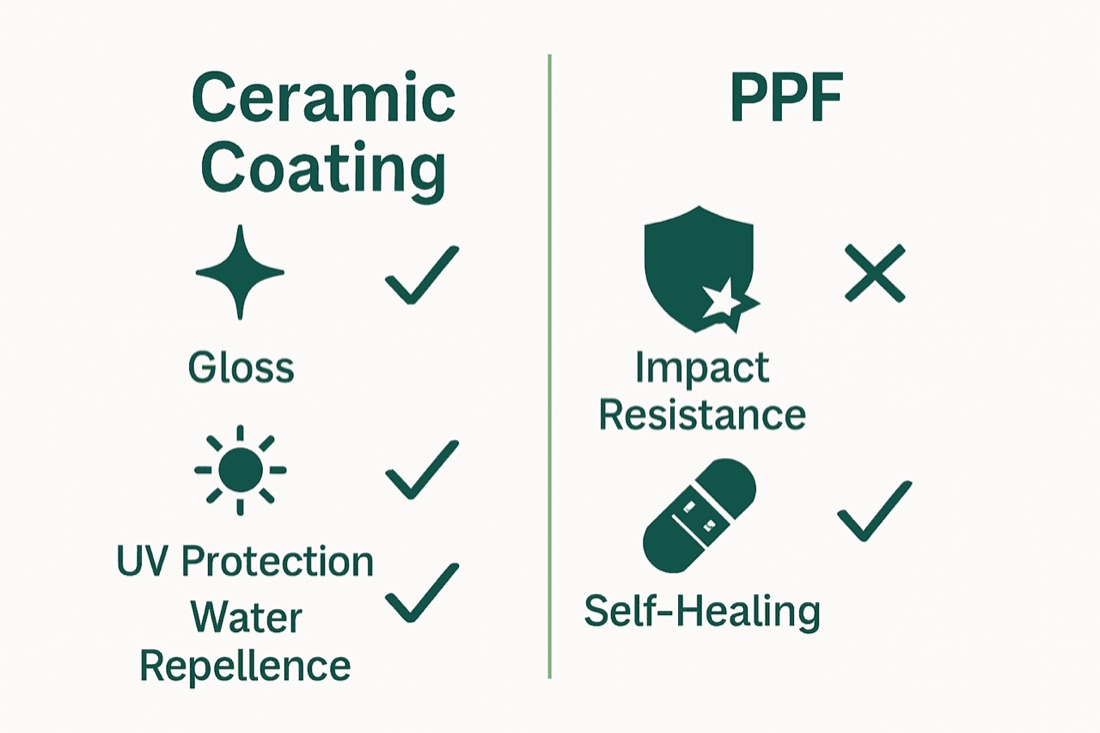
They aren't mutually exclusive — film on the high-impact front end with a coating over the rest is a common combination on higher-value cars. For most drivers, a coating alone is the sensible balance of cost and benefit.
Costs and common mistakes
Ceramic coating prices vary enormously, which makes comparing quotes difficult. Broadly, DIY kits sit at the low end, mobile professional application in the middle, and multi-layer studio work with extensive correction at the top. The variable that moves the price most isn't the coating — it's how many hours of paint correction the car needs first.
Our paint protection starts from £480. Where a car needs significant correction, we'll quote for that separately and explain why rather than folding it into a vague headline figure.
Mistakes that ruin a coating
- Skipping the preparation — coating over swirl marks locks them in for years
- Applying in the wrong conditions — damp or dusty air causes uneven curing and high spots
- Uneven application — leaves visible streaks that need polishing off
- Washing too soon — the coating needs a week before it's fully hardened
- Automatic car washes afterwards — the fastest way to undo the investment
Red flags in a quote
- "Ceramic coating, one hour, £99" — that's a ceramic-infused spray sealant, not a coating
- No mention of polishing on a car with visible swirls
- A promise it can be applied in the rain
- A ten-year guarantee with no maintenance schedule attached
Is it worth it?
For a car you're keeping, with paint worth protecting — particularly a dark colour that shows every mark — yes. The benefit owners notice most isn't the showroom finish on day one; it's that six months later the car still looks good and takes half as long to wash.
For a lease car going back in eighteen months, a good sealant makes more sense, and we'll say so. If you're not sure which applies, ask us — we'd rather recommend the cheaper option than sell you a coating you don't need.
Frequently asked questions
What is ceramic coating for cars?
Ceramic coating is a liquid polymer that chemically bonds to your car's factory paint and cures into a hard protective layer. It repels water and dirt, blocks UV damage and resists chemical staining from things like bird droppings and road salt.
How long does ceramic coating last?
A professionally applied coating typically lasts two to five years. Consumer-grade DIY products last up to two years, and hybrid coatings one to two. Lifespan depends heavily on aftercare — pH-neutral shampoo and avoiding automatic car washes make a real difference.
Can ceramic coating be applied at my home?
Yes. We apply ceramic coating as a mobile service across West London and bring our own water and power. It needs a dry day and ideally some shelter, such as a garage or a sheltered driveway, because the coating must stay dry while it cures.
How much does ceramic coating cost in West London?
Our paint protection starts from £480, with the final price depending on the size of the vehicle and the condition of the paintwork. Cars needing significant paint correction before coating are quoted separately, so you can see exactly what you're paying for.
Does ceramic coating stop scratches and stone chips?
No — that's the most common misconception. A coating resists chemical etching and very light marring, but it won't prevent stone chips or scratches from careless washing. Paint protection film is the option for physical impact protection.
How should I wash a ceramic-coated car?
Use a pH-neutral shampoo and the two-bucket method with a clean microfibre mitt, and dry with a soft towel or blown air. Avoid automatic car washes with spinning brushes entirely, and don't wash the car at all for the first seven days after application.